In the rapidly evolving digital health landscape of 2026, Artificial Intelligence (AI) has transitioned from an experimental novelty into an active, everyday component of clinical workflows. However, as AI drives deeper into core clinical operations, the regulatory scrutiny and safety standards surrounding it have reached an unprecedented peak.
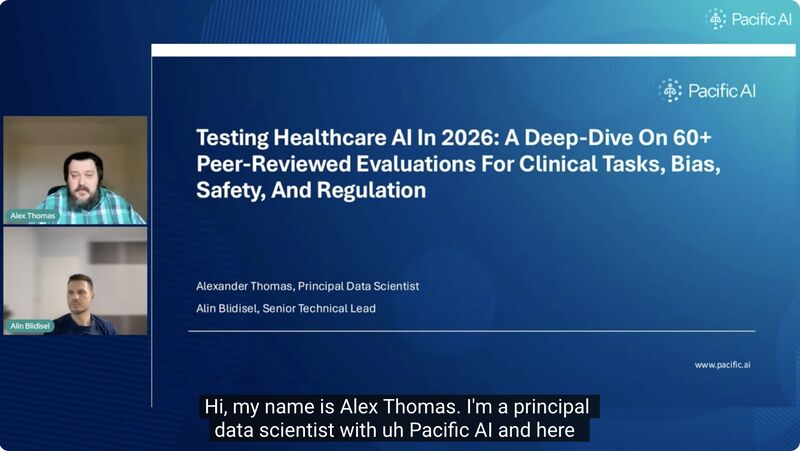
Recently, the CAREKONECT team tuned into the highly anticipated industry webinar hosted by Pacific AI: “Testing Healthcare AI In 2026: A Deep-Dive On 60+ Peer-Reviewed Evaluations For Clinical Tasks, Bias, Safety, And Regulation.” This comprehensive session mapped out more than 60 peer-reviewed testing suites designed to evaluate AI on clinical accuracy, safety, and systemic bias. The overarching message for 2026 was loud and clear: The accountability and compliance burden has officially shifted to the deployment organizations and the clinical workflow platforms integrating these tools.
As a software provider dedicated to optimizing digital healthcare workflows, CAREKONECT views clinical safety and rigid compliance not just as features, but as our core foundation. Here is how we are aligning our platform with these newly defined 2026 industry standards.
1. Navigating the Era of Responsibility Shift: Workflow as a Compliance Shield
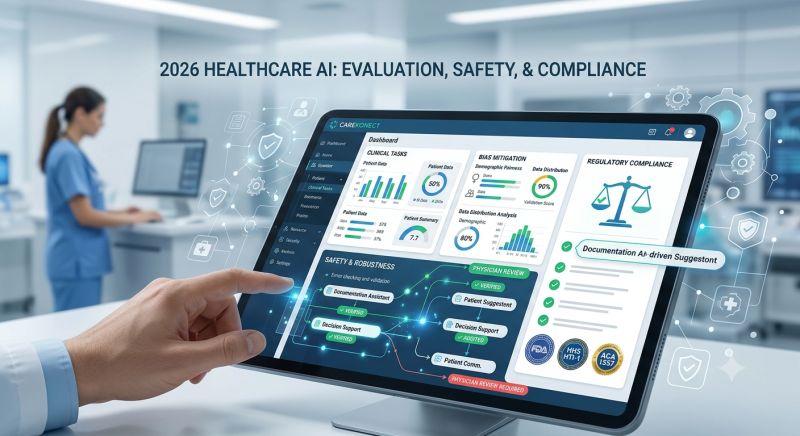
The webinar highlighted the tightening web of modern healthcare regulations, explicitly pointing to the FDA's updated lifecycle management guidelines for AI devices, the HHS HTI-1 transparency mandates, and ACA Section 1557's stringent anti-discrimination clauses for clinical algorithms.
> The Core Consensus: In 2026, regulators are no longer just examining the static AI model in isolation; they are heavily auditing how the AI performs and maintains transparency within live clinical workflows.
At CAREKONECT, we understand that digital workflows serve as the vital bridge connecting AI intelligence with frontline clinicians. To ensure that our platform's AI-assisted capabilities—ranging from automated documentation to intelligent scheduling and patient communication—remain completely bulletproof, we are actively championing a Governor-Gatekeeper-Guardian framework:
- End-to-End Transparency: We ensure that every AI-driven insight or administrative recommendation surface-leveled to a clinician is backed by traceable data lineage, seamlessly aligning with HTI-1 transparency requirements.
- Built-in Compliance: By looking toward the latest CHAI (Coalition for Health AI) standards, we aim to integrate automated Model Cards and safety benchmarks directly into our backend, giving healthcare organizations peace of mind the moment they deploy CAREKONECT software.
2. Eliminating “Clinical Hallucinations” Through Rigorous Testing
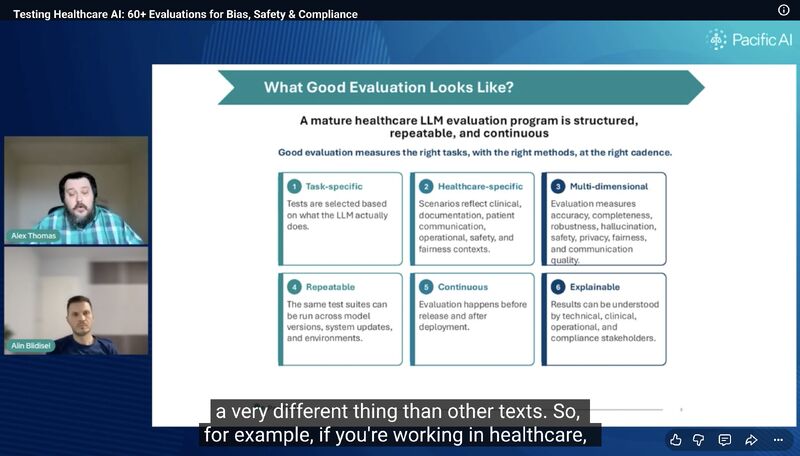
Pacific AI demonstrated an extensive matrix of over 60 healthcare-specific testing suites, pulling from open-source and proprietary engines like MedHELM and HealthBench. These suites are specifically designed to intercept hidden “hallucinations” in clinical reasoning, administrative documentation, and patient-facing communication.
In a live clinical environment, even a 1% margin of error can disrupt patient care or administrative integrity. CAREKONECT mitigates this through a philosophy of Clinical Cognition Alignment:
- Scenario-Based Probing: We advocate for testing AI modules within the specific context of real-world workflows, stress-testing how the software handles edge cases and localized clinical nuances.
- “Human-in-the-Loop” Safeguards: Our workflow architecture is fundamentally designed so that AI never operates in a vacuum. CAREKONECT ensures that every AI-generated clinical note, summary, or patient message is subject to final clinician review and sign-off, effectively neutralizing the inherent unpredictability of LLMs.
3. Rooting Out Algorithmic Bias to Ensure Equitable Care
Algorithmic equity is a non-negotiable benchmark for 2026 AI auditing. The Pacific AI session detailed how demographic, cognitive, and societal biases can quietly seep into AI systems, inadvertently skewing patient assessments and resource allocation.
CAREKONECT is committed to building software that serves diverse patient populations fairly. We ensure equity by design:
- We continuously review workflow logic to guarantee that associated AI features maintain consistent, unbiased evaluation standards across different demographic groups.
- We actively support the integration of bias-mitigation auditing tools to ensure that digital transformation narrows the healthcare equity gap rather than widening it.
Looking Ahead: Safer Workflows, Better Healthcare
Participating in Pacific AI's deep-dive webinar validates CAREKONECT's current product roadmap and clarifies the future of clinical software engineering.
The ultimate goal of healthcare digitization is to liberate clinicians from administrative burdens so they can focus on what matters most: patient care. By transforming the world's most rigorous AI evaluation standards into practical, safe, and seamless digital workflows, CAREKONECT continues to be the trusted partner healthcare institutions can rely on in 2026 and beyond.
To learn more about how CAREKONECT builds safety and compliance into your digital clinical workflows, reach out to our team or request a platform demonstration today.