A Recent Article Got Us Thinking
This week, we came across an insightful article from Pacific AI:
"HealthBench Professional in Gatekeeper: What 525 Physician-Authored Tasks Do and Don't Measure."
The article explores HealthBench Professional, an open benchmark from OpenAI designed to evaluate AI performance on realistic clinician-facing tasks.
What caught our attention wasn't simply which model achieved the highest score.
It was a much more important question:
When an AI system performs well on a healthcare benchmark, what does that actually tell us - and what does it still leave unanswered?
For us at CareKonect, this question feels increasingly relevant as we continue exploring how AI can support real healthcare workflows.
Read the original Pacific AI analysis
From Medical Exams to Real Clinical Work
One reason HealthBench Professional is interesting is that it moves healthcare AI evaluation closer to the work clinicians actually perform.
According to Pacific AI's analysis, the benchmark contains 525 tasks selected from 15,079 candidate conversations, created by 190 physicians across 26 specialties and 50 countries. The tasks cover three broad categories:
- Care consultation
- Writing and documentation
- Medical research
Around 36% of the final benchmark consists of red-team conversations designed to expose weaknesses in AI systems.
This is an important evolution.
Healthcare professionals don't spend their days answering multiple-choice medical questions.
They interpret information, prepare documentation, communicate with patients, review evidence, coordinate care, and make decisions within complex clinical environments.
OpenAI similarly describes HealthBench Professional as an evaluation focused on real clinician chat tasks, using physician-authored conversations and rubrics, multi-stage physician adjudication, and careful filtering.
Moving evaluation closer to these real-world activities gives us a more meaningful picture of what healthcare AI can actually do.
But it still doesn't tell us everything.
A Strong Benchmark Score Is Only Part of the Picture
This was one of the most important points in the Pacific AI article.
HealthBench Professional can provide useful evidence about how effectively a model handles clinician-facing tasks.
But Pacific AI emphasizes that the benchmark does not, by itself, measure areas such as bias and fairness or broader safety and reliability.
For example, it doesn't tell us whether an AI system behaves differently when certain patient attributes change.
It doesn't establish whether sensitive health information is appropriately protected.
And it doesn't tell us whether the same clinical information will produce sufficiently consistent behavior when it is reworded, translated, or restructured.
These are different questions.
And they require different evaluation methods.
So a high benchmark score shouldn't automatically become:
"This AI is ready for healthcare."
Instead, it should become:
"This is one useful piece of evidence. What else do we need to know?"
The Idea That Resonated Most With Us
One line in the Pacific AI analysis particularly stood out to us:
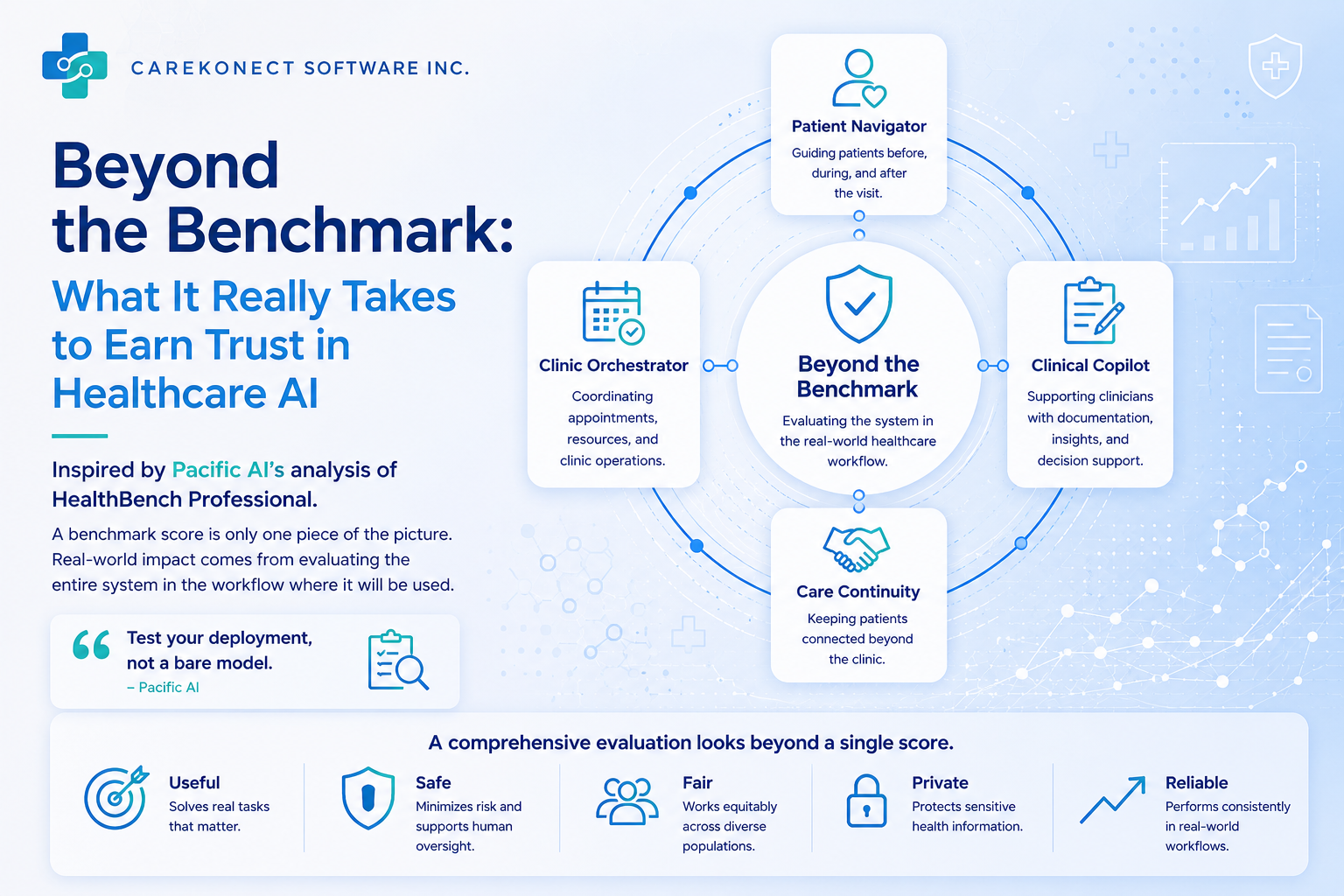
"You test your deployment, not a bare model."
This distinction matters.
A healthcare AI product isn't simply an underlying language model.
The actual experience may involve:
Model + system instructions + healthcare knowledge + retrieval + workflow logic + access controls + guardrails + integrations + human oversight.
Pacific AI argues that evaluation should therefore be performed against the actual endpoint and configuration being deployed - not simply against the underlying foundation model.
That idea made us think about our own direction at CareKonect.
Healthcare professionals and patients don't interact with benchmark scores.
They interact with complete systems operating inside real workflows.
What Does This Mean for CareKonect?
CareKonect's vision isn't centered around building one general-purpose healthcare chatbot.
We're developing an AI-powered healthcare platform around several capabilities supporting different stages of the patient and clinic journey:
Patient Navigator
Supporting patient intake, guidance, and engagement.
Clinic Orchestrator
Helping coordinate scheduling, resources, and operational workflows.
Clinical Copilot
Supporting clinicians with documentation and workflow intelligence.
Care Continuity
Helping maintain patient engagement and follow-up beyond the visit.
Looking at HealthBench Professional through this lens led us to an important realization:
Different AI capabilities shouldn't necessarily be evaluated in exactly the same way.
A Patient Navigator supporting intake operates in a very different context from a Clinical Copilot assisting a healthcare professional.
A Clinic Orchestrator coordinating schedules and resources faces different operational risks from an AI capability supporting clinical information.
And Care Continuity introduces another set of considerations around patient communication and follow-up.
The more specific the workflow becomes, the more important workflow-specific evaluation becomes.
From Model Evaluation to Workflow Evaluation
This changes one of the fundamental questions we ask about healthcare AI.
Instead of only asking:
"How intelligent is this model?"
We should increasingly ask:
"How well does this AI capability perform the specific job it has been given, inside the workflow where it will actually be used?"
Depending on that job, meaningful evaluation may need to consider several dimensions:
- Useful - Does it solve the intended real-world problem?
- Safe - Are appropriate safeguards and human oversight in place?
- Reliable - Does it behave consistently in the situations that matter?
- Fair - Are we examining performance across relevant populations and circumstances?
- Private - Is sensitive health information appropriately protected?
- Workflow-aware - Does it fit how healthcare teams actually work?
HealthBench Professional contributes useful evidence to part of this picture. But, as Pacific AI's analysis emphasizes, one benchmark shouldn't be treated as the complete answer.
Healthcare AI Is Moving From "Can It?" to "Can We Trust It?"
The first stage of generative AI was largely about demonstrating capability.
Can AI summarize this information?
Can it draft this clinical note?
Can it answer this question?
Can it help automate this task?
Those questions still matter.
But once AI begins participating in real healthcare workflows, another set of questions becomes just as important:
- Can it do this consistently?
- Do we understand where it fails?
- Do we know when a human should take over?
- Can we detect when a model or system update changes its behavior?
- Can healthcare professionals understand the role AI is playing?
And ultimately:
Can we trust it within the workflow where it is being used?
That represents an important transition for healthcare AI - from demonstrating intelligence to demonstrating dependability.
What We're Taking Away at CareKonect
Reading Pacific AI's analysis of HealthBench Professional reinforced something we believe will become increasingly important as healthcare AI matures:
The future of healthcare AI won't be defined by benchmark scores alone.
Models will improve.
Benchmarks will evolve.
New AI agents will emerge.
But healthcare organizations ultimately need more than impressive models.
They need systems that can be evaluated in the context in which they actually operate.
For CareKonect, that means continuing to think not only about what our AI capabilities can do, but also about how they should be evaluated within the specific workflows they're designed to support.
We're still building toward that future.
And as our platform evolves, questions around responsible AI, workflow-specific evaluation, privacy, reliability, and appropriate human oversight will continue to influence how we think about the technology we create.
Because in healthcare, building smarter AI is only part of the challenge.
Building AI that healthcare teams can understand, evaluate, and trust is what really matters.
Industry Reference
This article was inspired by Alin Blidisel's August 11, 2026 analysis for Pacific AI, "HealthBench Professional in Gatekeeper: What 525 Physician-Authored Tasks Do and Don't Measure." The original article provides a deeper technical discussion of benchmark coverage, data contamination, judge-model dependency, deployment-level testing, version drift, and the limits of using a single benchmark for healthcare AI evaluation.
Read the full Pacific AI article
HealthBench Professional was developed by OpenAI as an open benchmark focused on realistic clinician-facing tasks across care consultation, writing and documentation, and medical research.