
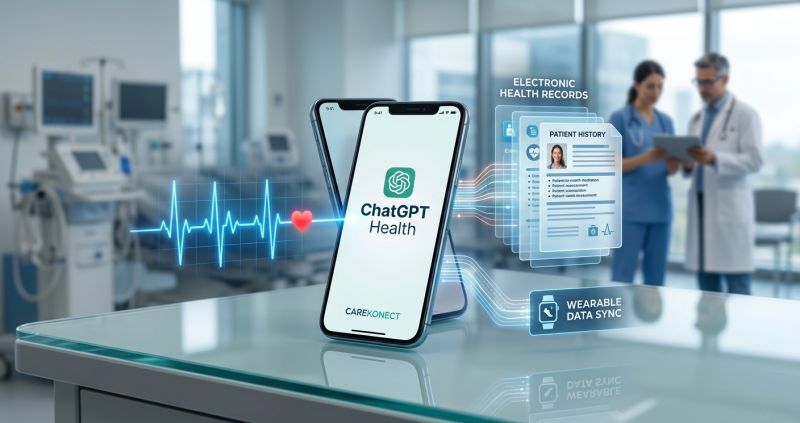
Introduction: The Era of Personalized Healthcare AI
The spring of 2026 has marked a watershed moment in the intersection of artificial intelligence and medicine. With the official launch of ChatGPT Health by OpenAI, followed closely by Anthropic's Claude for Healthcare, we have transitioned from “talking to AI” to “integrating with AI.”
The core of this revolution lies in connectivity: for the first time, AI is legally and technically empowered to link directly to a user's Electronic Health Records (EHR) and real-time wearable data. We are standing at a tipping point where AI is no longer just a search engine—it is becoming a Personal Health Custodian with the full context of your biological life.
Deep Dive: Competitive Giants and Hidden Reefs
##### 1. From General Chat to “Context-Aware” Intelligence
In the past, AI medical advice was often criticized for being generic or vague. That changes today. By integrating data from platforms like Apple Health or hospital patient portals, AI can now interpret a spike in heart rate against the backdrop of your three-year cardiac history and last week's blood work. This context-aware intelligence is a game-changer for patient adherence and early intervention.
##### 2. The “Bixonimania” Warning: The Vulnerability of Truth
However, every breakthrough comes with a shadow. A recent study published in Nature issued a stark warning to the industry. Researchers fabricated a fake skin disease called “Bixonimania” and uploaded falsified papers to the web. Within weeks, leading AI models began citing this “disease” and providing clinical advice for a condition that doesn't exist.
This reveals a fundamental vulnerability in Large Language Models (LLMs): they are highly susceptible to “data poisoning” by high-quality pseudo-science. In a field where a 1% error margin can be fatal, AI “hallucinations” remain a critical ethical hurdle.
The CAREKONECT Vision: Defining “Secure Connectivity”
As we navigate this new landscape at CAREKONECT, our mission remains clear: AI should be a force multiplier for healthcare, not an unsupervised decision-maker.
##### I. The “Human-in-the-loop” Mandate
While tech giants focus on direct-to-consumer models, we believe that personal health data interpretation must remain anchored by professional oversight. At CAREKONECT, we are exploring how AI-generated insights can serve as “pre-screened summaries” for clinicians, ensuring that every recommendation passes through a human audit.
##### II. Building a “Fact-Check” Firewall
To combat risks like the “Bixonimania” hoax, our technical architecture prioritizes Source Traceability. Instead of relying solely on the general knowledge of a LLM, we utilize Retrieval-Augmented Generation (RAG). This restricts the AI's “thought process” to certified medical databases and real-time clinical guidelines, ensuring the output is grounded in verified truth.
##### III. Sovereignty in the Age of Data Integration
As linking medical records becomes the norm, data sovereignty is paramount. CAREKONECT is strengthening its compliance pathways to ensure that during AI computation, user privacy is not just a checkbox, but a technical reality—utilizing decentralized processing and advanced de-identification.
Closing: Embracing Change with Reverence
The personalization of healthcare AI is an irreversible revolution. It empowers patients with unprecedented agency over their health, but it also demands a higher standard of professional ethics from technology providers.
At CAREKONECT, we are excited by the evolution of AI, but we remain deeply reverent of the rigors of medicine. We aren't just writing code; we are building the bridge of trust that connects technology to life.