Artificial intelligence is rapidly becoming part of healthcare. But as the industry moves beyond experimentation, an increasingly important question is emerging:
How does AI become part of the clinical workflow clinicians already use every day?
A recent Canadian deployment offers an interesting example.
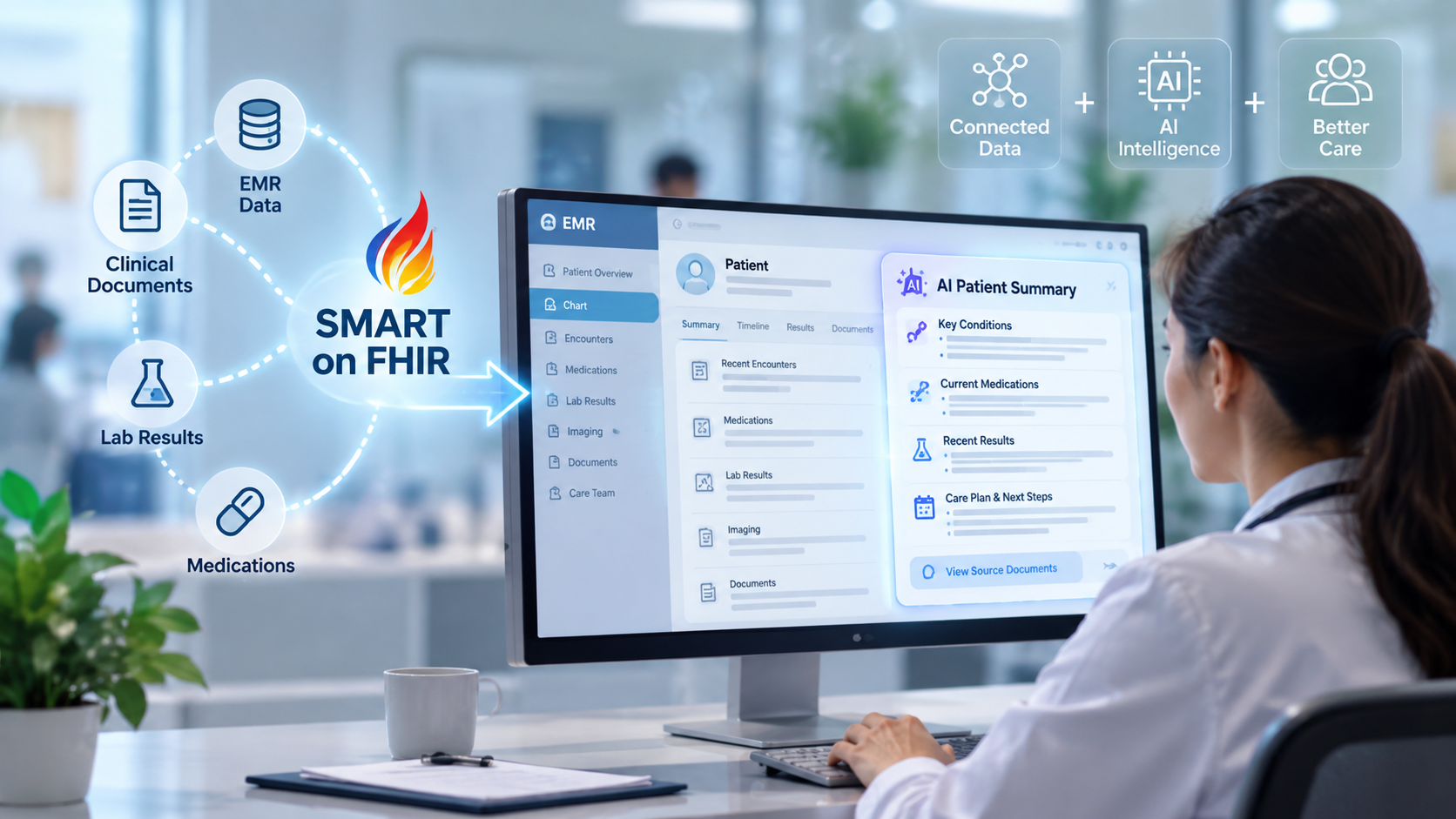
In September 2026, HEALWELL AI announced the deployment of its SMART Summary clinical AI application to more than 400 clinicians across New Brunswick. The technology generates structured summaries from information distributed across patient records and delivers them directly within the Profile electronic medical record (EMR).
What makes this development particularly interesting is not only the AI itself.
It is how the AI connects to the healthcare system.
AI Inside the Workflow
SMART Summary is delivered as a SMART on FHIR application, allowing the technology to operate within an existing EMR environment rather than requiring clinicians to move between disconnected systems.
That distinction matters.
Healthcare professionals already work across complex combinations of clinical records, laboratory results, medication histories, referrals, documentation and administrative workflows. Adding another standalone AI interface may introduce capability, but it can also introduce another workflow.
The more meaningful opportunity is to bring intelligence to the point where clinical work is already happening.
SMART on FHIR provides one technical approach to making that possible.
Built on the FHIR healthcare data standard and widely adopted authorization technologies, SMART on FHIR enables applications to securely connect with compatible health information systems while maintaining the clinical context of the user and patient.
For AI applications, this can create a bridge between intelligence and interoperability.
From Connected Data to Useful Intelligence
Interoperability has traditionally focused on enabling healthcare systems to exchange information.
AI introduces another layer.
Once information can move between systems in standardized ways, intelligent applications can potentially help clinicians interpret, organize and act on that information more effectively.
The New Brunswick deployment illustrates this progression.
Rather than asking clinicians to manually review information distributed across multiple parts of a patient record, the AI application can generate a structured summary while maintaining links back to the underlying source documentation.
A Canadian Direction
This development also reflects a broader shift underway in Canadian digital health.
Canada Health Infoway continues to advance national interoperability initiatives designed to improve how health information is accessed, exchanged and used across the continuum of care.
Its Vendor Innovation Program has also supported the evaluation of emerging technologies in real clinical environments. SMART Summary was evaluated through the program with clinicians in Ontario, British Columbia and New Brunswick before the current deployment.
For healthcare technology companies, this signals an important direction:
AI innovation and interoperability can no longer be treated as separate challenges.
The future of clinical AI will depend not only on increasingly capable models, but also on whether those models can operate securely, transparently and effectively within the systems healthcare professionals already rely on.
What This Means for CareKonect
At CareKonect, this direction closely aligns with how we think about connected healthcare technology.
Our work across Patient Navigator, Clinic Orchestrator, Clinical Co-Pilot and Care Continuity is based on the idea that healthcare technology should support the broader care journey rather than create another isolated digital tool.
Interoperability standards such as FHIR provide an important foundation for that vision.
As AI capabilities continue to evolve, the opportunity is not simply to build smarter individual features. It is to connect patients, clinicians, information and workflows in ways that make care easier to navigate and clinical technology easier to use.
The next phase of healthcare AI may therefore be defined by more than intelligence alone.
It will be defined by connected intelligence - AI that can work securely within healthcare workflows, understand the right context and help turn fragmented information into meaningful action.
That is where interoperability and AI begin to become part of the same conversation.